In-depth guide
RAID: Shadow Legends explained: how it plays, what it costs, and what to check first
Advertising disclosure
This page is funded by advertising. The buttons on it are partner links: if you follow one and install the game, Celusagruna s.r.o. may be paid a commission by the advertiser. You pay nothing extra, and the commission does not buy a favourable review. Where this guide is critical of the game — and it is, in places — that criticism stands regardless of the commercial relationship.
Read the editorial policy for how advertising is kept separate from what is written here.
A collection RPG with a very large champion roster, a turn-based combat system that rewards planning, and a monetisation model that deserves to be described plainly rather than glossed over. This guide does both.
What the game actually is
RAID: Shadow Legends is a free-to-download collection role-playing game. You assemble a small team of champions, send them into turn-based battles, and spend what you win on making that team stronger so it can survive harder battles. There is a story campaign, but the campaign is a means to an end: the long game is building teams that can clear specific pieces of content.
Two things distinguish it from a conventional RPG. The first is that you do not choose your characters — you draw them at random from summoning items. The second is that individual character power comes mostly from equipment and stat tuning rather than from story progression. Both points matter more than any feature list, and both are covered below.
It is worth being blunt about genre. This is a gacha game: a game built around randomised draws that can be accelerated with money. That is not a criticism by itself — plenty of people enjoy the format — but a guide that describes the game without saying so is not describing the game.
Who makes it and who owns it
The game is developed and published by Plarium Games, a studio founded in Israel with offices in several countries. Ownership has changed twice in the game's lifetime, which is worth knowing if you are reading older articles:
| When | What happened |
|---|---|
| August 2017 | Aristocrat Leisure acquired Plarium, reported at around USD 500 million plus an earn-out. |
| 4 July 2018 | RAID: Shadow Legends released on mobile. |
| 21 January 2020 | PC client released. |
| November 2024 | Aristocrat agreed to sell Plarium to Modern Times Group (MTG), reported at up to USD 820 million. |
| February 2025 | The sale to MTG completed. MTG is the current owner. |
The game is built in Unity. Its marketing history is also part of the public record: during 2019 and 2020 it ran an unusually heavy sponsored-video campaign across YouTube and Twitch, heavy enough that the sponsorship read became an internet joke. In February 2020 that campaign drew criticism over how clearly the sponsorships were being disclosed to viewers. We mention it because this page is itself advertising-funded, and it would be odd to hold ourselves to a disclosure standard while staying quiet about the same issue elsewhere.
Where it runs
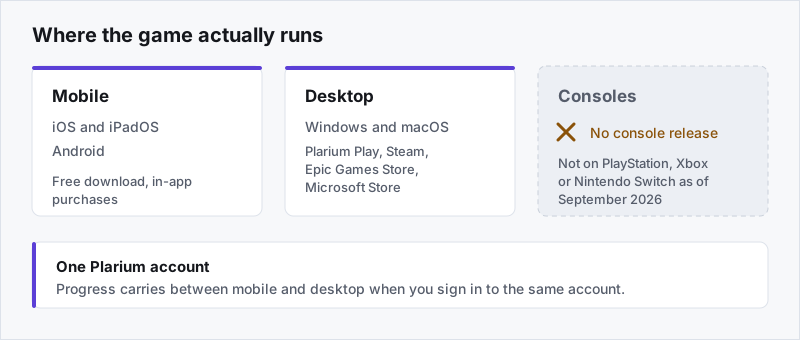
Mobile: iOS, iPadOS and Android. Desktop: Windows and macOS, through Plarium's own Plarium Play launcher, and also through Steam, the Epic Games Store and the Microsoft Store. Signing in to the same Plarium account carries your progress between mobile and desktop.
There is no console version. The game has not been released on PlayStation, Xbox or Nintendo Switch. If you have read otherwise — including in an earlier version of this page — that was wrong, and it is listed in the corrections.
Expect a multi-gigabyte install, and expect it to grow as content is added. We are not quoting a figure because the download size changes with each release and differs by platform; the store listing you install from shows the current one.
Partner link. If you install the game through it, Celusagruna s.r.o. may be paid a commission by the advertiser. It costs you nothing extra and it does not change anything you pay inside the game.
How combat works
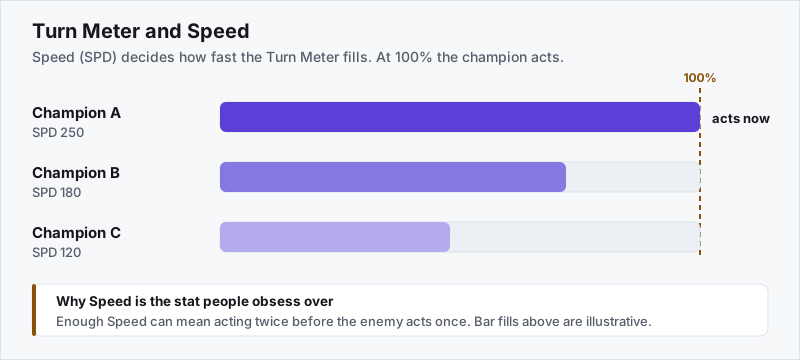
Battles are turn-based and automatic-capable: you bring a team, and each champion acts when its Turn Meter fills. The meter fills in proportion to the champion's Speed statistic, so Speed is not one stat among many — it is the stat that decides who acts, how often, and in what order.
On top of turn order sits an affinity system. Champions and enemies each belong to one of four affinities — Magic, Spirit, Force and Void. Three of them form a strong-against cycle, and Void sits outside it, neither strong nor weak against anything. Attacking into an unfavourable affinity gives you a meaningful chance of a weak hit, which is why most players end up keeping more than one team.
Beyond that, champions carry active skills on cooldowns, passive skills, and status effects applied to both sides. The practical skill in the game is less about reflexes than about sequencing: making sure the right debuff lands before the big attack, and that your healer acts before, not after, the enemy's heavy hit.
Champions, factions and rarity
Champions are organised into 16 factions — among them Banner Lords, Barbarians, Dark Elves, Demonspawn, High Elves, Knight Revenant, Lizardmen, Ogryn Tribes, Orcs, Skinwalkers, The Sacred Order, Undead Hordes, Dwarves, Shadowkin, Sylvan Watchers and, added in early 2026, Argonites. Faction membership matters mechanically, because one mode (Faction Wars) only lets you field champions of a single faction.
Rarity runs Common, Uncommon, Rare, Epic, Legendary and Mythical. Higher rarity generally means a higher stat ceiling and more interesting skills, but rarity is not the same as usefulness: several of the most widely recommended champions for early and mid-game content are Rares, and plenty of Legendaries are situational.
The roster is very large and grows continuously. Community champion databases listed more than a thousand champions during 2026. We are deliberately not quoting a precise count — any number printed here is out of date within weeks, and the in-game collection screen is the only authoritative source.
How you get champions
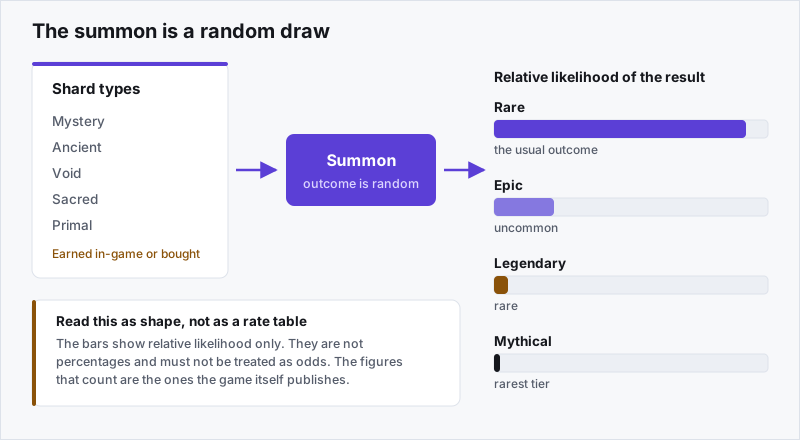
You do not pick champions. You open shards — Mystery, Ancient, Void, Sacred and Primal — and receive a randomly determined champion. Shards are earned through play and are also sold for real money, directly or bundled into packs.
Three honest points about this system:
- The high-rarity outcomes are genuinely unlikely. The overwhelming majority of standard shard pulls return the lowest rarity that shard can produce. The game publishes its summon chances; read them there rather than on a fan site, and read them before, not after, you buy.
- Spending does not guarantee a specific champion. Buying more shards buys more draws, not a chosen result. Any source telling you a particular purchase will get you a named champion is either describing a targeted event with its own explicit rules, or is wrong.
- Pity and mercy mechanics are discussed constantly in the community. Community trackers describe a system that improves your chances after a long run of failures. Treat community-derived thresholds as unverified: they come from aggregated player data, not from a published specification.
Want to see the summon screen for yourself?
The summon chances are displayed inside the game before you spend anything, and the download is free.
Partner link. If you install the game through it, Celusagruna s.r.o. may be paid a commission by the advertiser. It costs you nothing extra and it does not change anything you pay inside the game.
Gear, and why it matters more
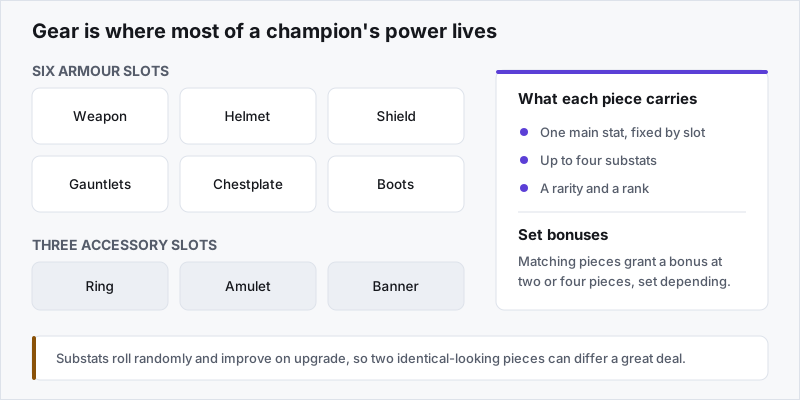
This is the part most introductory articles skip, and it is the part that decides whether your team works. A champion has six armour slots — Weapon, Helmet, Shield, Gauntlets, Chestplate and Boots — plus accessory slots for a Ring, an Amulet and a Banner.
Each piece carries one main stat, determined by the slot, and up to four substats. Those substats roll randomly and improve as the piece is upgraded. Matching pieces from the same set grant a set bonus, at two or four pieces depending on the set. The upshot is that two pieces that look identical in the inventory can be worth wildly different amounts, and that a well-geared Rare will outperform a badly geared Legendary in most content.
If you take one practical thing from this guide, take this: spend your upgrade materials on gear for a small number of champions rather than spreading thin across a large roster. The beginner guide goes into how to choose them.
The game modes
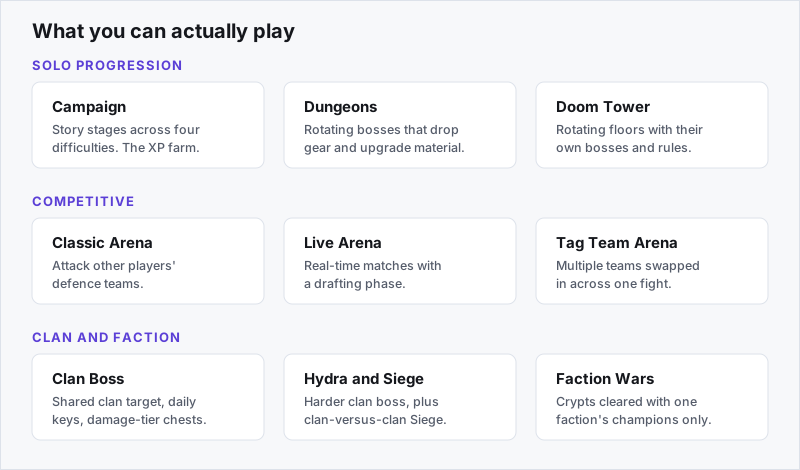
Content is split across solo progression, competitive play against other players, and clan content played with a group. A dedicated page covers each mode in more detail; in summary:
- Campaign — story stages across four difficulty settings. The main source of champion experience and early materials.
- Dungeons — a rotating set of bosses that drop gear and the materials used to ascend and upgrade champions.
- Doom Tower — rotating floors with their own bosses and restrictions.
- Arena — several formats, including asynchronous attacks on other players' defence teams, a real-time format with a drafting phase, and a multi-team format.
- Clan content — a shared clan boss fought with daily keys, a harder clan boss, clan-versus-clan Siege, and Faction Wars, which restricts you to one faction at a time.
Faction Wars is the mode that quietly shapes how you play. Because it requires a viable team from a single faction, it pushes you towards keeping champions you would otherwise discard — which is also, not coincidentally, a reason to keep playing.
The core loop and Energy
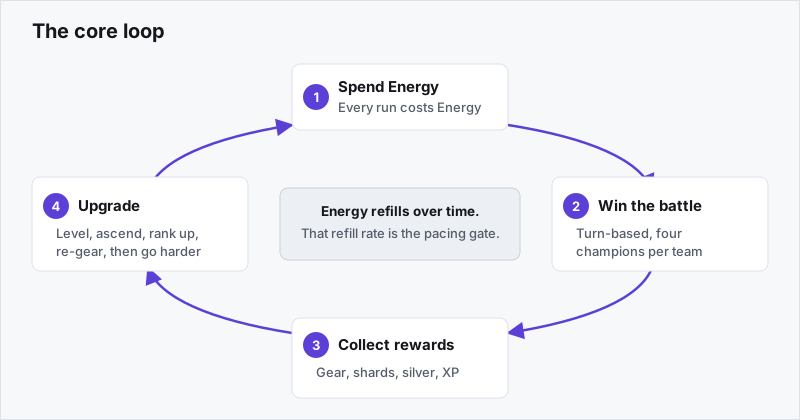
Battles cost Energy, Energy refills over time, and that refill rate is the real limit on how fast you progress. Silver is the routine in-game currency; Gems are the scarce one, and Gems are what real money most directly buys. Gems can be converted into Energy, which is another way of saying that money converts into time.
This is worth understanding before you spend, because it reframes the question. You are usually not buying power directly. You are buying a shorter wait, plus more random draws. Whether that is worth it is a personal judgement, but it is a clearer one when it is stated in those terms.
What it costs
The download is free and a large amount of content is reachable without paying. That is true, and it is the honest version of "free to play" here.
What is also true, and is often left out of promotional write-ups: this is a heavily monetised game. It sells shards, packs, Gems, Energy refills and recurring subscription-style offers, and it runs frequent limited-time promotions. Critical coverage has been blunt about it — the game has been described in critical reception as an extreme example of pay-to-win. Our own assessment is narrower and, we think, more useful:
- Nearly all content can be cleared without paying, given enough time.
- Top-tier competitive play against other paying players is a different matter. Claiming a free account competes on equal terms at the top of the Arena ladder is not credible.
- Money mainly buys speed and additional random draws, not certainty.
A claim we removed. An earlier version of this page stated that the game has "fair monetisation" and that free players "can compete effectively with paid players". We could not support that, it conflicts with the weight of published critical coverage, and it has been removed. The corrections section lists it with the others.
Age rating and spending controls
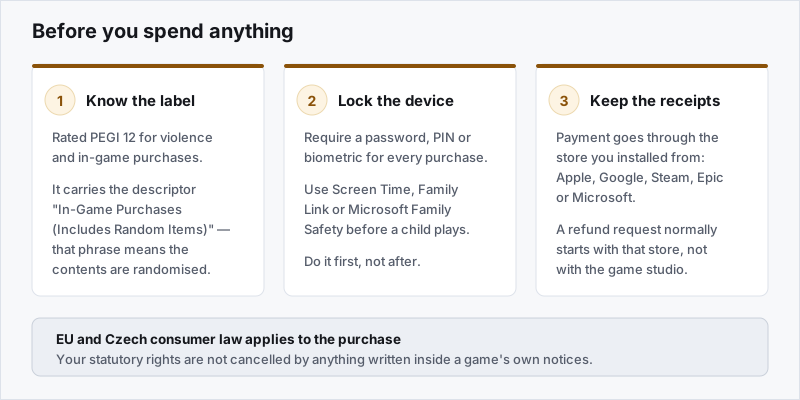
In Europe the game is rated PEGI 12, for violence and for in-game purchases. The relevant PEGI descriptor is "In-Game Purchases (Includes Random Items)" — the parenthetical is the part that matters, because it is the formal signal that what you buy has randomised contents.
Three things worth doing before anyone in your household spends money:
- Require authentication for every purchase at device level — a password, PIN or biometric — rather than relying on self-restraint mid-session.
- Set up family controls (Apple Screen Time, Google Family Link, Microsoft Family Safety) before handing a device to a child, not after a bill arrives.
- Know where a refund request goes. Payment runs through the store you installed from — Apple, Google, Steam, Epic or Microsoft — so that store is normally the first stop, not the game studio.
If you are in the EU, your statutory consumer rights apply to these purchases and are not removed by anything written in an in-game notice. Our spending and safety page goes into this further.
Who it suits, and who it does not
It suits you if you enjoy optimisation for its own sake — stat tuning, team composition, working out why a fight fails on turn three — and you are comfortable with randomised rewards and a long time horizon.
It does not suit you if you want a finite story you can finish, if randomised purchases are something you would rather avoid on principle or for personal reasons, or if you dislike daily-task design. Nothing here will change those things, and a guide that told you otherwise would be selling rather than informing.
Decide for yourself
The game is free to download and the summon chances are shown in the client, so the cheapest way to test any of the above is to look.
Partner link. If you install the game through it, Celusagruna s.r.o. may be paid a commission by the advertiser. It costs you nothing extra and it does not change anything you pay inside the game.
Corrections to an earlier version
This page previously carried claims we could not support. In line with our corrections procedure, they are listed rather than quietly deleted:
| Previous claim | Why it changed |
|---|---|
| "Platform: Mobile, PC, Console" and "Console versions are available for major platforms" | Removed. There is no PlayStation, Xbox or Nintendo Switch release. |
| "Progress is synced across mobile, PC, and console" | Corrected to mobile and desktop, via a Plarium account. |
| "Over 200 unique champions" | Badly out of date; community databases listed more than a thousand in 2026. Replaced with a statement that the roster is very large and the in-game collection is the authority. |
| "Active Community: 10M+ players" and "10M+ Active Players" | Removed. No audited active-player figure is published, and download counts are not player counts. |
| "Over 70% of players who start the game continue playing for more than 3 months" | Removed. We found no source for this figure and believe it was invented. |
| "Fair Monetization: Free players can compete effectively with paid players" | Removed. Not supportable, and contrary to the weight of published critical coverage. |
| "Unlike many mobile games that rely heavily on pay-to-win mechanics" | Removed. It inverted the game's actual critical reputation. |
| "Raid Boss: A massive world boss" and "Alliance Wars" | Corrected to the real mode names: Clan Boss, Hydra Clan Boss, Siege and Faction Wars. Groups are called clans, not alliances. |
| "Support team typically responds within 24-48 hours" | Removed. We have no way to verify a response-time claim about a third party. |
| "Performance is generally excellent ... the game's file size is reasonable" | Removed as unmeasured. Install size and performance vary by platform and release. |
| "Updated for 2025" | Replaced with a real publication date and a named author. |
Sources and method
Everything above is either mechanically checkable in the game client, or drawn from the public sources below. Where a figure changes over time — roster size, install size, prices, summon rates — we describe the mechanism and point you at the in-game display rather than printing a number that will be wrong next month.
- Wikipedia, Raid: Shadow Legends — release dates, platforms, modes, critical reception, marketing controversy.
- Wikipedia, Plarium — studio background and ownership.
- Business Wire, PC release announcement, 21 January 2020.
- MTG, acquisition of Plarium, and trade coverage of the completed sale in February 2025.
- Plarium's own game page and the platform store listings, for current platform availability and store descriptors.
- PEGI age rating and content descriptors as shown on the European store listings.
Where this guide and the publisher disagree, the publisher wins
This is an independent guide. If anything here diverges from the game's own official information — Plarium's website, the in-game notices, the store listing, the terms of service or the published summon chances — the official information prevails and you should rely on it, not on us. Game mechanics, prices and availability change without notice. If you spot something out of date or wrong, please tell us; we correct errors and say what we corrected.
Trade mark notice. miravain.online is operated by Celusagruna s.r.o. and is not affiliated with, endorsed by or sponsored by Plarium Games, Modern Times Group, or any other game publisher or platform named on this page. "RAID: Shadow Legends", "Plarium" and all other names and logos referred to are the trade marks of their respective owners and are used here for identification and descriptive purposes only.
About the visuals. Every diagram on this site is an original SVG drawn by us for this article. There are no product screenshots, no promotional artwork and no stock photography, and no image is loaded from a third-party server.